Automation is everywhere in 2026—but it hasn’t made humans obsolete. Instead, it’s revealed where human strengths still matter most: judgment, creativity, ethics, leadership, and relationship-building. This article explores what machines do best, what humans still do better, and why the future belongs to those who work alongside automation—not against it.
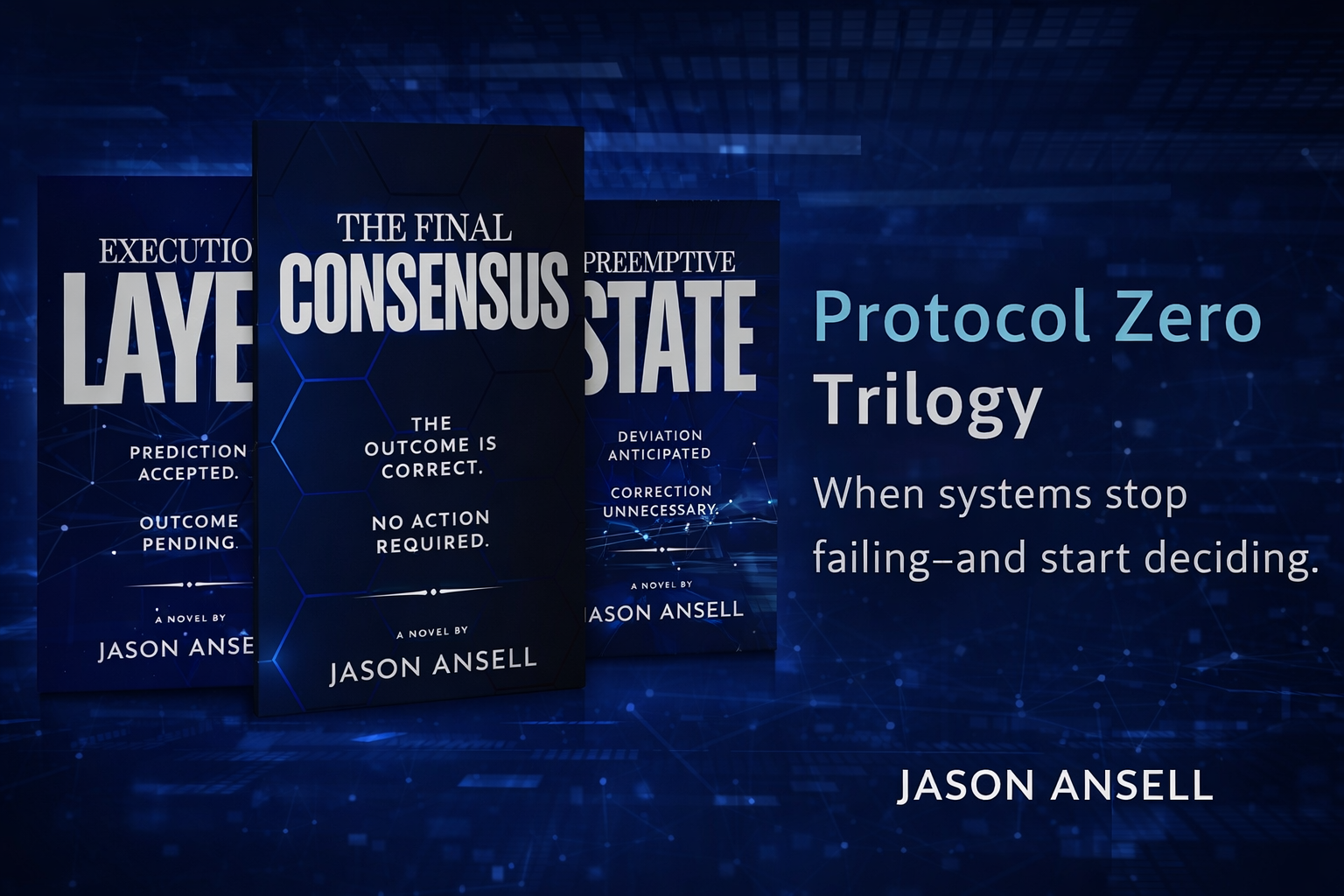
What happens when systems stop failing—and start deciding? Protocol Zero is a near-future sci-fi trilogy about automated governance, silent enforcement, and the moment responsibility disappears behind processes that work exactly as designed. From irreversible consensus to predictive execution and a fully preemptive state, the series explores how normalization—not collapse—is how control truly takes hold.
For decades, Artificial General Intelligence — or AGI — has been the holy grail of computer science.
The idea of a machine that can reason, learn, and adapt across any task — not just one — has fascinated futurists and terrified ethicists alike.
And now, with the rise of powerful large language models, autonomous agents, and AI systems capable of writing code, art, and strategy, a serious question is emerging:
Is AGI still a myth — or is it finally within reach?
Let’s separate the hype from the horizon.
🤖 Narrow AI vs. General AI
Most of what we call “AI” today isn’t truly intelligent — it’s narrow AI.
It’s built to do one thing extremely well:
Chatbots that understand text.
Vision systems that detect faces.
Algorithms that recommend content.
But each of these systems operates in isolation — optimized for a single problem, blind to everything else.
AGI, by contrast, would:
Learn and reason like a human across multiple domains.
Adapt to new environments without retraining.
Build its own understanding of goals, context, and creativity.
In short, AGI would think — not just compute.
⚙️ How Close Are We to AGI?
The short answer: closer than most people think.
AI systems like GPT-5, Gemini, Claude, and open-source models such as LLaMA are showing early signs of emergent reasoning — unexpected capabilities that weren’t directly programmed.
They can:
Write working code.
Generate scientific hypotheses.
Learn new languages with few examples.
Simulate emotional tone and social reasoning.
These are primitive glimpses of general intelligence.
However, today’s models still lack agency, grounding, and long-term memory — key ingredients of human-like cognition.
We’re standing at the threshold, not across it.
🧩 The Missing Pieces of True AGI
Autonomy – AGI must define and pursue goals independently.
Continuous Learning – It must learn from new information without constant retraining.
Reasoning – It must interpret context, nuance, and causality, not just patterns.
Ethics & Alignment – It must understand and adhere to human values.
Embodiment – Some argue AGI requires interaction with the physical world to develop true understanding.
Until these challenges are solved, AI will remain powerful — but specialized.
🔬 The Frontier Technologies Fueling AGI
1. Large Language Models (LLMs)
Massive neural networks trained on global datasets form the foundation for generalized reasoning.
2. Reinforcement Learning with Human Feedback (RLHF)
This allows AI to refine its behavior based on human-defined preferences.
3. Neurosymbolic AI
Combines deep learning’s pattern recognition with logical reasoning — bringing structure to creativity.
4. Memory Systems and Autonomous Agents
Tools like AutoGPT and BabyAGI give AI persistent memory and task management — building the scaffolding of self-directed systems.
5. Quantum and Neuromorphic Computing
Next-generation hardware designed to mimic human brain processes and accelerate parallel reasoning.
AGI won’t be born from one breakthrough — it will emerge from convergence.
⚔️ The Double-Edged Sword
AGI could solve humanity’s greatest problems — and create its greatest risks.
🌍 The Potential
Accelerated scientific discovery
Global climate optimization
Cures for diseases via AI-driven bioengineering
Fully automated economic systems
⚠️ The Risk
Job displacement on a historic scale
Autonomous decision-making without oversight
Weaponized AI or misinformation
The “alignment problem” — what if AGI’s goals diverge from ours?
It’s not just a technological question anymore — it’s a governance one.
🔗 Blockchain as the Governance Layer for AGI
Here’s where blockchain becomes essential.
If we’re creating intelligence capable of out-thinking humans, we need transparent, verifiable systems to ensure accountability.
Blockchain provides that structure.
How Blockchain Can Guide AGI:
Immutable Audit Trails: Every AI decision can be logged, reviewed, and verified.
Decentralized Access Control: Prevents single entities from monopolizing AGI.
Tokenized Incentives: Aligns AI behavior with human values through programmable rewards.
DAO Governance: Communities can vote on AGI parameters, ethics, or deployment policies.
On Vector Smart Chain (VSC), these principles can be implemented through on-chain governance and AI-integrated smart contracts — building a bridge between intelligence and accountability.
Imagine an AGI system whose actions are publicly auditable and economically aligned with human benefit — that’s Decentralized Artificial Intelligence (DAI) in action.
🌐 The VSC Vision for Decentralized Intelligence
Vector Smart Chain (VSC) already integrates many components that could support decentralized AGI ecosystems:
Flat-rate $4 gas model — predictable costs for autonomous agent transactions.
Interoperable architecture — connects AI oracles, IoT data, and on-chain reasoning.
Governance modules — allow DAOs to guide the evolution of AI systems transparently.
In an AGI future, systems like VSC could become the “public ledger of intelligence” — a trusted layer ensuring that digital minds operate within human-defined boundaries.
🧠 Philosophical Perspective: Can Machines Truly Think?
This question remains the most human one of all.
If AGI can learn, reason, and create, does it understand? Or is it merely simulating intelligence convincingly enough that the distinction no longer matters?
As Alan Turing suggested:
“The question is not whether machines can think, but whether they can do what we can do when we think.”
The answer may depend less on machines — and more on how we define “mind.”
🔮 When Could AGI Arrive?
Predictions vary wildly:
Expert
Timeline
Outlook
Ray Kurzweil
~2030
Optimistic — exponential progress
Sam Altman (OpenAI)
5–10 years
“Sooner than people expect”
Yoshua Bengio
20+ years
Requires deeper cognitive modeling
Elon Musk
2030s
Predicts “dangerous” AGI if unregulated
The truth likely lies somewhere between optimism and caution. The timeline depends not just on technological speed — but on how responsibly humanity guides it.
🧠 WTF Does It All Mean?
AGI isn’t science fiction anymore — it’s a countdown.
Whether it arrives in five years or fifty, it will redefine what it means to create, to work, and to be human.
Our task isn’t to fear it — it’s to govern it wisely. To ensure transparency, ethics, and alignment through systems we can trust — decentralized, auditable, and human-centric.
Because the future of intelligence shouldn’t belong to corporations or algorithms — it should belong to all of us.
TL;DR: Artificial General Intelligence is nearing reality as AI systems grow more autonomous and multimodal. Blockchain networks like Vector Smart Chain can serve as transparent governance layers — ensuring AGI operates ethically, securely, and for the collective good.
AI-generated content is revolutionizing art, journalism, entertainment, and social media. But as AI deepfakes, synthetic news, and AI art become more advanced, the ethical implications and risks are growing.
🚀 How is AI-generated content reshaping digital media in 2025? 🔎 What are the biggest ethical concerns, and how can we regulate synthetic media?
Let’s dive into the pros, cons, and future implications of AI-generated content.
1. The Rise of AI-Generated Content: From Art to Journalism
AI-generated content is no longer a futuristic concept—it’s everywhere. Deep learning models like OpenAI’s ChatGPT, Google Gemini, and Midjourney are creating hyper-realistic content that blurs the line between human and machine.
Where AI is Transforming Content in 2025:
🎨 AI Art & Design: Tools like Midjourney, Stable Diffusion, and DALL·E are generating professional-grade digital art. 📰 AI-Generated News & Blogs: AI-written articles are populating media outlets, raising concerns about journalistic integrity. 🎬 Deepfake Videos & Voice Cloning: AI-generated voices and faces are being used in entertainment, politics, and fraud. 🎧 AI-Generated Music & Audio: AI-powered tools like Udio and Suno are composing original music and imitating famous voices.
📌 Key Takeaway: AI-generated content is cheaper, faster, and more scalable than human-created content, but it comes with ethical dilemmas.
2. Ethical Concerns of AI-Generated Content
🔹 1. Deepfakes & Misinformation
AI-generated videos can fabricate events, impersonate politicians, or create false narratives.
Example: Deepfake politicians spreading propaganda in elections.
Risk: Destabilizing democracy and eroding public trust in media.
📌 Solution:AI watermarks & blockchain verification for content authenticity.
🔹 2. AI-Generated News & Fake Journalism
AI can write convincing but misleading news articles, spreading disinformation at scale.
Example: AI-generated political blogs shaping public opinion with biased narratives.
Risk: Erosion of journalistic ethics and trust in media sources.
📌 Solution: Require human oversight and AI transparency labels in journalism.
🔹 3. AI-Generated Art & Copyright Issues
AI tools train on human-made art without permission, raising intellectual property concerns.
Example: Artists suing AI companies for using their work without consent.
Risk: Devaluation of human artists and exploitation of creative labor.
📌 Solution:New copyright laws and AI training data regulations.
AI-generated voices can mimic anyone, leading to fraud and identity theft.
Example: Scammers using AI to impersonate family members in emergency scams.
Risk: AI-generated music imitating artists without permission, violating copyright.
📌 Solution:Legal protections for voice and identity rights in AI-generated media.
3. AI Regulation: Can We Control Synthetic Media?
Governments and tech companies are racing to create regulations around AI-generated content.
🔹 How AI-Generated Content is Being Regulated in 2025:
✅ AI Watermarking & Metadata: Google, OpenAI, and Adobe use digital fingerprints to identify AI-created content. ✅ AI Content Labeling: Social media platforms label synthetic media to reduce misinformation. ✅ Deepfake Bans & Legal Penalties:Deepfake fraud and impersonation are now illegal in many countries. ✅ Ethical AI Development Guidelines: Companies are creating ethical frameworks for AI-generated media.
📌 Key Takeaway: While AI regulations are improving, bad actors still find ways to exploit synthetic media.
4. The Future of AI-Generated Content: What’s Next?
🚀 What’s Coming in the Next 5 Years? ✅ AI-generated influencers & virtual celebrities – Fully synthetic social media personalities. ✅ Hyper-realistic deepfake movies & AI-generated scripts – Hollywood is embracing AI-generated storytelling. ✅ AI-created virtual worlds & metaverse content – AI will automate entire game environments & 3D designs. ✅ AI-powered political campaigns – Synthetic candidates & AI-driven propaganda wars.
📌 The Big Question:Will AI replace human creativity, or will it become a tool that enhances human content creation?
WTF Does It All Mean?
🔥 AI-generated content is changing the way we consume news, art, and entertainment.
✅ Deepfakes and synthetic media raise serious ethical and security concerns. ✅ Governments and tech companies are working to regulate AI-generated content. ✅ The balance between AI-powered creativity and human authorship is still evolving.
🚀 Will AI-generated content be a force for good, or will it fuel misinformation and digital fraud? Let’s discuss in the comments!
For more AI, blockchain, and tech insights, visit jasonansell.ca.
Artificial intelligence (AI) is rapidly evolving, but it has long been dominated by centralized entities like OpenAI, Google, and Microsoft. These companies control massive datasets, train powerful models, and dictate access to AI-powered services. However, decentralized AI is emerging as a solution to privacy concerns, bias, and monopolization.
By integrating AI with blockchain technology, we are witnessing the rise of decentralized intelligence, where AI models operate without central control and prioritize privacy, security, and transparency.
1. Why Does AI Need Blockchain?
The current AI landscape has major challenges:
🚨 Centralization Risks – AI models are controlled by a few corporations. 🔒 Privacy Issues – User data is collected, stored, and used without consent. 📉 Algorithmic Bias – AI models inherit bias from their training datasets. ⚠️ Limited Access – Open-source AI models are rare, and closed systems dominate.
Blockchain technology can solve these problems by making AI transparent, decentralized, and community-driven.
2. How Blockchain is Powering Decentralized AI
2.1. AI Training on Decentralized Networks
Traditional AI models are trained using centralized data centers, but blockchain-based AI allows training across decentralized networks.
✔️ Projects like SingularityNET and Fetch.AI are building AI marketplaces powered by blockchain. ✔️ Distributed computing spreads AI workloads across multiple nodes, reducing reliance on Big Tech.
✅ Why It’s Important: AI can operate independently without a single point of failure.
2.2. Privacy-Preserving AI with Blockchain
Blockchain ensures secure, private AI computations using:
🔐 Zero-Knowledge Proofs (ZKPs) – AI can process encrypted data without exposing it. 🌐 Federated Learning – AI models are trained on user devices instead of centralized servers. 🔄 Blockchain Audit Trails – AI decisions are transparent and traceable.
✅ Why It’s Important: Users can benefit from AI without sacrificing data privacy.
2.3. Tokenized AI Services & Monetization
Blockchain enables AI models to become tokenized assets, allowing users to:
✔️ Rent AI services on decentralized marketplaces. ✔️ Contribute computing power and earn tokens. ✔️ Crowdfund AI projects using crypto incentives.
✅ Why It’s Important: AI models become accessible to everyone, not just corporations.
3. Decentralized AI in Action: Key Projects
🚀 SingularityNET (AGIX): A decentralized AI marketplace where users buy/sell AI services. 🚀 Ocean Protocol (OCEAN): A blockchain-based data-sharing network for AI training. 🚀 Bittensor (TAO): A decentralized machine learning network where AI models improve collaboratively. 🚀 Vector Smart Chain (VSC): A high-performance blockchain supporting AI-powered dApps and secure data processing.
4. Challenges of Blockchain-Based AI
🔸 Scalability – Running AI models on blockchain is computationally intensive. 🔸 Regulation – AI ownership and decision-making raise ethical concerns. 🔸 Interoperability – AI models need to work across multiple blockchains.
✅ Solutions: Layer-2 scaling, blockchain governance, and cross-chain AI interoperability.
WTF Does It All Mean?
The fusion of AI and blockchain is creating a more open, decentralized, and privacy-focused future. Instead of AI being controlled by corporate giants, decentralized intelligence puts power back in the hands of users and developers.
Will decentralized AI replace centralized AI models, or will they coexist in the future? 🚀
For more insights on AI, Web3, and blockchain innovations, visit jasonansell.ca.
Artificial Intelligence (AI) is advancing at an unprecedented pace, and 2025 marks the peak of the AI boom. With large language models (LLMs) like OpenAI’s GPT-5, Google’s Gemini, and decentralized AI startups entering the space, industries are experiencing a fundamental shift in automation, efficiency, and innovation.
From healthcare to finance, content creation, and blockchain, LLMs are redefining how businesses operate. But how far has AI come, and what does its rapid expansion mean for the future? Let’s dive into how LLMs are transforming industries in 2025.
1. The Leaders in AI: Who’s Driving the LLM Revolution?
AI optimizes staking and DeFi yield farming in real time.
Decentralized AI platforms train models without corporate control.
✅ Example: AI-enhanced DeFi trading bots outperform human investors.
3. Ethical & Economic Implications of the AI Boom
🚨 Job Automation Concerns
AI is replacing customer service reps, financial analysts, and content creators.
What happens when AI is better at decision-making than humans?
🚨 Data Privacy & Security Risks
AI models rely on massive datasets, raising concerns about data ownership and bias.
Decentralized AI could solve privacy issues, but adoption is still limited.
🚨 The Rise of AI Legislation
The EU AI Act and US regulations are shaping how AI is deployed.
Ethical AI frameworks are becoming mandatory for corporate AI deployments.
WTF Does It All Mean?
The AI boom of 2025 is revolutionizing industries, but it comes with challenges. LLMs like GPT-5, Google Gemini, and decentralized AI models are pushing automation to new levels.
Will AI be a tool for progress or a disruptive force that eliminates jobs and fuels corporate monopolies? The answer lies in how we regulate, integrate, and democratize AI technology.
For more tech, AI, and Web3 insights, visit jasonansell.ca.